

Organization Background
This non-profit organization is the international governing body for a major competitive sport and is recognized by global sporting authorities. With a long-standing history in the sport, it oversees key aspects worldwide – ranging from rules and eligibility standards to major international events and long-term development initiatives.
Operating as a global federation headquartered in Europe, the organization supports a large network that includes:
- A worldwide community of athletes, officials, judges, umpires, event organizers, and volunteers
- Over 100 national member organizations
- Over 100 recognized competition categories (representing different competition categories/equipment types)
- Committees, commissions, and working groups responsible for governance, regulation, safety, eligibility, rules, and events
The Challenge
The organization’s constitutional and regulatory proposal process involves multiple levels of review: the Executive Office, reporting committees, recommending parties, and final approval bodies (such as the Board of Members or Council). Their existing monday.com structure was functional but no longer meeting the demands of the organization.
Key challenges included:
- Difficulty updating proposals once submitted through a form.
- Form limitations—such as no dropdowns and no ability to edit existing items—that required significant manual work.
- Loss of proposal numbers when items moved between boards, impacting governance traceability.
- Need for a public-facing submission form to allow external individuals to propose changes and follow progress.
- Complex permission considerations, balancing committee involvement with licence cost constraints.
- Inconsistent workflows that made it harder for different committees to follow a unified process.
A recognition from the team that a rebuild may serve them better than retrofitting their current setup.
Given the organization’s size and governance responsibilities, they needed a more reliable, structured system that could support formal decision-making across global committees and ensure accuracy throughout the proposal lifecycle.
The Solution
The Simpleday team built a connected workflow using monday Work Management, monday WorkForms, and Make.com to automate proposal movement, maintain consistent data, and support the organization’s governance structure.
Aligned terminology and mapped columns:
Standardized naming and column mapping across all relevant boards within monday Work Management to support reliable automation and reduce maintenance..
Simpleday:
Cross-board automations (monday Work Management + Make.com):
Built Make.com scenarios that automatically create or update linked items across consultative bodies, reporting committees, and deciding-body boards.
Proposal ID as the primary key:
Standardized Proposal ID so monday Work Management and Make.com always update the correct item, regardless of which board triggers the change.
Dynamic proposal numbering system:
Created a quarterly auto-incrementing numbering format (e.g., 001Q2), backed by a small database and integrated with monday Work Management for accuracy and automated resets.
Status syncing across decision bodies:
Configured logic so approvals and rejections automatically update the original record in the Executive Review Board and move items into the correct groups using native monday automation.
Submitter classification (monday WorkForms + formula logic):
Added automated rules to categorize submitters based on form inputs, with an administrator override when needed.
The Impact
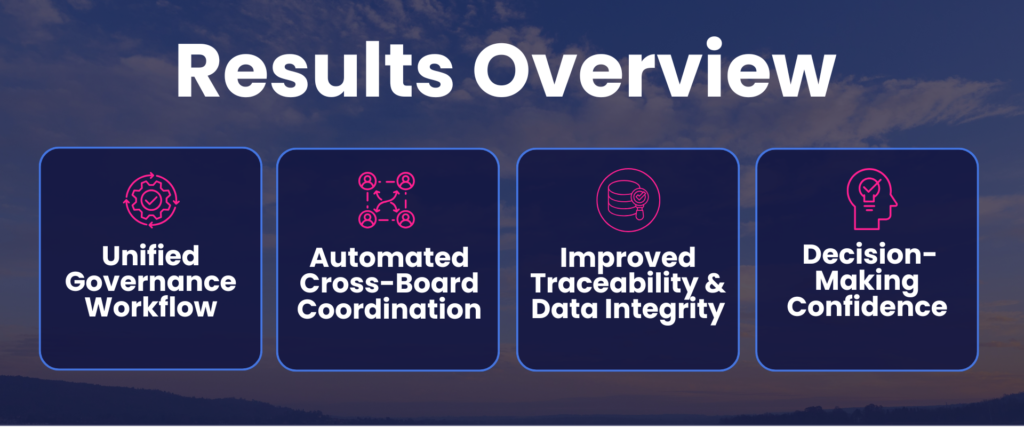
The new workflow gives the organization a clearer, more reliable way to manage proposals from consultation through final decision.
- Proposal IDs now stay consistent across all boards.
- A significant portion of manual cross-board updates has been automated.
- Committees, the Executive Office, and deciding bodies all work from the same core data.
- Proposal numbering is accurate, structured, and easier to report on.
- Submitter types are identified consistently for governance and analysis.
Overall, the organization now has a workflow that better reflects the complexity of its global governance process while reducing repetitive work and improving confidence in the data behind each decision.
